9 Best Adjustable Rolling Pins for Baking (November 2026)
The best adjustable rolling pins for baking include the MTNZXZ Rolling Pin and Silicone Pastry Mat for stainless steel sets with a mat, the QUELLANCE Stainless Steel Rolling Pin & Baking for fondant and pastry work, and the Geesta Adjustable Wood Rolling Pin for long teak rolling with measurements.
On this page (9 sections)
- How we compared adjustable rolling pins for baking
- The best adjustable rolling pins for baking, by score
- Side-by-side comparison
- What ring thicknesses do you need for pie, cookies and pasta?
- Should you pick stainless steel or wood for an adjustable rolling pin?
- How long should an adjustable rolling pin be for your counter?
- Do you need a pastry mat with your adjustable rolling pin?
- How do you roll dough evenly with thickness rings?
- Verdict: which adjustable rolling pin should you buy?
The best adjustable rolling pins for baking are the MTNZXZ and QUELLANCE sets for most homes, because they pair a 17-inch steel pin with four ring sizes and a measured mat. Our score weighs specs, features and buyer feedback against what you're shopping for.
Even thickness matters more than it sounds. A pie crust that is thin at the edges and thick in the middle can crack, while cookies that differ by a few millimeters bake at different rates.
Rings set a stop you can feel, so each pass has a limit.
If you want a wider view of pin shapes first, read what is the best type of rolling pin. It explains French, American and tapered styles before you pick a material.
Our picks at a glance
-
1
 Best for stainless steel sets with a mat
MTNZXZ Rolling Pin and Silicone Pastry Mat
9.6/10 our score
See it on Amazon -
2
 Best for fondant and pastry work
QUELLANCE Stainless Steel Rolling Pin & Baking
9.5/10 our score
See it on Amazon -
3
 Best for long teak rolling with measurements
Geesta Adjustable Wood Rolling Pin
9.3/10 our score
See it on Amazon
- 4
 Best for five color-coded wood settingsCheck it
- 5
 Check it
Vinoil Classic Wood Rolling Pin
Best for wood pins with a mat and stand - 6
 Check it
Folksy Super Kitchen Rolling Pin with Thickness Rings
Best for large 9 to 16 inch sheets - 7
 Check it
BAMBOO LAND Adjustable Rolling Pin with Thickness Rings
Best for compact pastel wood rolling - 8
 Check it
U-Taste Adjustable Rolling Pin
Best for engraved marks and chilled rolling - 9
 Check it
LUSHYUM 304 Stainless Steel Adjustable Rolling Pin
Best for steel with wooden handles and stand
How we compared adjustable rolling pins for baking
We compared length, ring count, ring sizes, barrel material, included mats and stands, and how each pin handles common dough. We checked the specs for each model and looked at buyer patterns around cleaning, storage and ring fit.
Steel pins in this group stay cool and wipe clean. Wood pins feel warmer and can grip dough more.
Neither is better for every recipe, so the right pick depends on your dough and your drawer space.
If you shop by handle shape next, see the best adjustable rolling pin with handles. If you want a steel-only shortlist, see the best adjustable stainless steel rolling pin.
What the specs do and do not tell you
Specs give length, weight and ring size, but they do not show how a pin feels under pressure. A heavier barrel can flatten stiff bread dough with less arm effort, while a lighter pin gives finer control for thin pasta.
For grip and control with one hand, see our one-handed rolling pin guide.
Weight also affects how long you can roll a large batch without fatigue.
Ring material matters in daily use as well. Silicone rings flex slightly and grip the surface, while PP rings hold a firmer edge.
Neither changes the stated thickness, but fit and ease of removal change how often you will switch settings during a session.
How ring count affects daily baking
More rings help when one session moves from cookies to pie crust to pizza. Fewer rings keep the drawer simpler and make the current setting harder to misread.
The best count is the one you will actually change during a bake, not the longest list on the box.
The best adjustable rolling pins for baking, by score
The MTNZXZ leads this group on score because it combines four ring sizes with a large mat in a 17-inch steel pin. The QUELLANCE follows with the same ring pattern and a measured mat.
Wood options take the next spots for buyers who prefer beech or teak.
MTNZXZ Rolling Pin and Silicone Pastry Mat: Best for stainless steel sets with a mat
- 17 in 304 stainless steel pin
- Four rings at 1/16, 1/8, 1/4 and 3/8 in
- Silicone pastry mat about 23.6 x 15.7 in
- Rings remove for a straight pin
A 17-inch stainless pin with four thickness rings and a large silicone mat for even dough.
Pros
- Four useful thickness steps
- Large mat for big dough
- Smooth steel surface cleans easily
Cons
- Heavier than wood pins
- Mat adds storage space
The MTNZXZ suits bakers who roll pie, pizza, cookies and pasta on one surface. Its 17-inch 304 stainless steel barrel stays smooth and cool, and MTNZXZ says the satin finish wipes clean.
Four detachable rings give 1/16, 1/8, 1/4 and 3/8 inch steps. That range covers dumpling wrappers and pasta at the thin end, plus thick pizza and chewy cookies at the thick end.
The 2 mm, 4 mm, 6 mm and 10 mm equivalents make the steps easier to match to recipes written in metric.
The silicone mat measures about 23.6 x 15.7 inches with measurements and conversion tables. You can size dough on the mat instead of moving it to a ruler, and the mat is rated from -40 to 450 degrees Fahrenheit for use as a table mat.
Its non-sticky surface also helps lift soft dough without tearing.
Take off all rings and the pin becomes a straight roller for fondant or freeform dough. The trade-off is weight and storage: steel at 0.65 kg is heavier than wood, and the mat needs flat space.
That is a fair exchange if you want one set to cover most bakes.
QUELLANCE Stainless Steel Rolling Pin & Baking: Best for fondant and pastry work
- 17 in 430 stainless steel pin
- Four rings at 1/16, 1/8, 1/4 and 3/8 in
- Pastry mat with measurements
- Rings remove for a straight pin
A stainless pin and measured mat set aimed at fondant, pie, pizza and cookies.
Pros
- Same four steps as the top pick
- Measured mat helps sizing
- Satin steel finish wipes clean
Cons
- 430 steel grade differs from 304
- Steel feels cold on hands
QUELLANCE suits fondant, pie and cookie bakers who want steel with a mat. Its 17-inch 430 stainless steel pin has a satin brushed finish, and QUELLANCE says it resists rust.
The four rings match the top pick at 1/16, 1/8, 1/4 and 3/8 inch. Use 1/16 for tortellini, pierogi, pasta and noodles, and 3/8 for thick pizza, pie crust and chewy cookies.
The middle steps suit crunchy cookies, thin pizza and everyday pie work, so four settings cover most home recipes in one session.
A pastry mat with measurements helps you roll dough to the size you need. After rolling, the mat wipes clean, which saves time on sticky dough days.
That pairing matters for fondant, where you need smooth sheets and quick sizing checks without tools.
Remove every ring for a plain fondant roller. QUELLANCE says the steel grade differs from 304 sets, so choose this one for the mat and feel rather than grade alone.
The pin still gives the same thickness steps, but grade and included mat decide between the two steel sets.
Geesta Adjustable Wood Rolling Pin: Best for long teak rolling with measurements
- Teak wood pin, 23 in overall
- Five PP ring options
- Laser-etched inch and cm marks
- Wooden holder and phone rest
A long, heavy teak pin with five rings and measurement marks on the pin itself.
Pros
- Five ring sizes
- Measurements on the barrel
- Long reach for large sheets
Cons
- Heaviest pick here
- Wood needs hand care
Geesta suits bakers who want a long wood pin with marks on the barrel. It is 23 inches overall with a 14-inch middle section, so large pie sheets need less repositioning.
Five food-grade PP rings slide on to set height. Geesta says each ring is marked, and the pin has laser-etched centimeter and inch marks for dough size.
Those marks help you check diameter while you roll, which is useful for chapati, dumplings and round pie crusts where size matters as much as thickness.
The teak body is water-resistant per Geesta, and the handle press design gives a French-style feel. A wooden holder steadies the pin and can prop up a phone or tablet, and Geesta says the rings clean in a dishwasher.
That holder also stops a long pin from rolling off the counter between passes.
This is the heaviest pick at 2.6 pounds, which helps pressure but can tire hands on huge batches. Wood also needs gentler washing than steel.
Choose Geesta for reach and marks, or a lighter pin for frequent small batches.
Joseph Joseph PrecisionPin: Best for five color-coded wood settings
- Beech wood pin, 16.54 in
- Five sets of removable rings
- Settings about 2, 4, 6, 8 and 10 mm
- Use with no rings if needed
A beech pin with five color-coded ring sets for biscuit dough, pizza bases and pastry sheets.
Pros
- Five settings including 8 mm
- Clear color coding
- Light at 0.42 kg
Cons
- No mat included
- Wood care needed
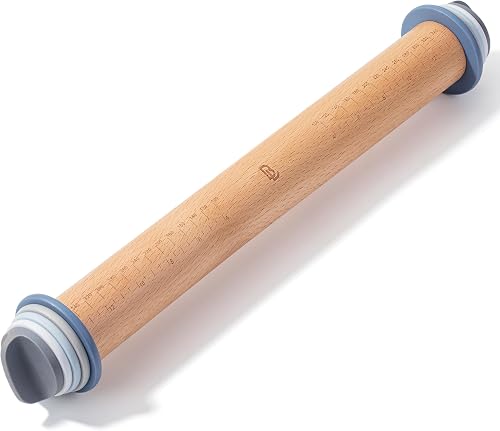
The Joseph Joseph PrecisionPin suits bakers who want clear steps in wood. It is 16.54 inches of beech with five sets of removable rings that twist off.
Settings run about 2 mm, 4 mm, 6 mm, 8 mm and 10 mm. That 8 mm step is rare here and helps thick biscuit dough and sturdy pizza bases.
It sits between standard cookie thickness and the thickest bread-roll setting, so it fills a gap left by four-ring pins.
Color-coded rings make the current setting easy to see at a glance. Joseph Joseph says the pin also works with no rings as a conventional roller, which helps for freeform pastry where you judge by hand.
The twist-off design means you do not need to pull rings past the handles.
At 0.42 kg, it is the lightest pin here, which helps control. The trade-off is no mat and wood care, plus plastic rings to track in a drawer.
Keep the ten rings together and the color system stays useful instead of becoming clutter.
Vinoil Classic Wood Rolling Pin: Best for wood pins with a mat and stand
- 17 in beech wood pin
- Silicone rings at 4 mm and 2 mm
- Silicone mat 23.6 x 15.7 in
- Wood stand and phone holder
A beech pin set with a silicone mat, two ring sizes and a wooden stand.
Pros
- Mat and stand included
- Smooth hand-polished wood
- Good for classic American rolling
Cons
- Only two ring thicknesses
- Less precise than five-ring pins
Vinoil suits classic wood rolling with a mat and stand. The 17-inch beech pin is hand-polished three times per Vinoil, with a smooth surface for pizza, pastry and bread dough.
Only two silicone rings are included, at 4 mm and 2 mm on each end. That suits pie crust, cookies and noodles, but it gives fewer steps than four- or five-ring pins.
In practice, you will rely more on feel for thicker cookies and pizza bases, while the rings anchor the thinner sheets.
The set includes a 23.6 x 15.7 inch silicone mat and a wooden base that doubles as a phone stand. The base steadies the pin between passes and keeps it off the counter.
Vinoil says the pin surface is non-stick and designed to limit flour residue.
Vinoil recommends oil 1 to 2 times a month for the wood. Choose this for the full set, or pick a five-ring pin if precise steps matter more.
The mat and stand are the reason to accept only two ring sizes.
Folksy Super Kitchen Rolling Pin with Thickness Rings: Best for large 9 to 16 inch sheets
- 17.5 in stainless steel pin
- Five silicone rings
- Printed measurement marks
- Dishwasher safe per maker
A long stainless pin with five rings and marks for large pie and pizza sheets.
Pros
- Five ring sizes
- Long barrel for big dough
- Measurement marks on barrel
Cons
- No mat or stand
- Ring sizes use inch decimals
Folksy suits large sheets and party batches. The pin is 17.5 inches long in stainless steel, with marks printed on the barrel for dough size.
Five silicone rings snap on and off in 0.08, 0.12, 0.2, 0.315 and 0.395 inch sizes. Folksy says the length helps make 9 to 16 inch pie crusts in a single pass.
Those steps cover cake pops, pierogi, bread, pasta and pancakes, not only pie and pizza.
The maker says the surface is non-stick and the pin is dishwasher safe. That helps cleanup after flour-heavy dough, though hand washing still protects the finish over time.
The sealed end construction is meant to keep dirt and moisture from being trapped inside the barrel.
Folksy states the steel as 304 in one place and 403 in another, so treat grade claims with care. No mat or stand is included.
For large rounds without a mat, the long barrel and marks do the work.
BAMBOO LAND Adjustable Rolling Pin with Thickness Rings: Best for compact pastel wood rolling
- 13.8 in wooden pin
- Four pastel ring sets
- Rings at 2, 4, 6 and 10 mm
- Marked rings by task
A shorter wooden pin with four marked pastel rings for dumplings, pie and cookies.
Pros
- Compact 13.8 in length
- Four clear settings
- Light at 0.55 kg
Cons
- Short for large sheets
- No mat included
BAMBOO LAND suits small kitchens and lighter dough work. The pin is 13.8 inches in natural wood, shorter than the 17-inch steel sets.
Four pastel ring sets give 2 mm, 4 mm, 6 mm and 10 mm. Each color is tied to tasks such as 2 mm for dumplings and pasta, 4 mm for pie and pancakes, 6 mm for cookies and 10 mm for bread rolls.
That task marking helps beginners choose a ring without measuring the result.
At 0.55 kg, it is easy to lift and store. The shorter barrel is controlled by the rings on both ends, which stop the sheet at the set height.
For dumpling wrappers and small cookies, that control matters more than reach.
No mat, stand or barrel marks are included. Pick it for compact storage and clear ring tasks, or choose a longer pin for big dough.
The short length also means less counter space needed during rolling.
U-Taste Adjustable Rolling Pin: Best for engraved marks and chilled rolling
- 16 in 18/8 stainless steel pin
- Four silicone rings
- Engraved measurement marks
- Arc groove rings act as a rest
A 16-inch steel pin with engraved marks, four rings and a ring design that rests the pin.
Pros
- Engraved marks do not wash off
- Steel can be chilled
- Rings keep pin off counter
Cons
- No mat included
- Narrower barrel than 17 in sets
U-Taste suits bakers who chill steel for sticky dough. It is a 16-inch 18/8 stainless steel pin with engraved measurement marks that U-Taste says will not wash off.
Four silicone rings set 1/16, 1/6, 1/4 and 3/8 inch heights. The rings have an arc groove, so they can rest the pin on the counter between passes.
That small detail keeps the barrel off the surface and reduces rolling across the worktop.
U-Taste says the smooth design keeps water from seeping in. You can also chill the barrel to keep butter firm while rolling pastry, pie crust and cookies.
Engraved marks help you shape pizza and pie dough to a set diameter without a separate ruler.
At 380.5 grams, it is lighter than the 17-inch steel sets. The trade-off is no mat, and the 16-inch length is tighter for very large sheets.
Choose it for chilled rolling and marks, or a mat set for sizing on the surface.
LUSHYUM 304 Stainless Steel Adjustable Rolling Pin: Best for steel with wooden handles and stand
- 304 stainless barrel, 10.4 in barrel
- Four ring sizes at 2, 3, 6 and 10 mm
- Measurement marks in inch and mm
- Wooden handles and stand with phone rest
A steel barrel with screw-on wooden handles, four rings and a stand that holds a phone.
Pros
- Wooden handles for grip
- Handles store inside barrel
- Stand doubles as phone holder
Cons
- Hand wash only
- Fewer reviews in this group
LUSHYUM suits buyers who want wooden handles on a steel barrel. The barrel has a 10.4-inch stainless section in a 20.2-inch total length, with inch and millimeter marks.
Four pairs of rings give 2 mm, 3 mm, 6 mm and 10 mm. The 3 mm step suits thin pastry and tortillas where a 2 mm sheet is too fragile.
The 6 mm and 10 mm steps cover cookies, pie crust, pizza and cinnamon rolls at the thick end.
Wooden handles screw on for grip and remove for storage inside the hollow barrel. A two-in-one stand holds the pin and a phone or tablet for recipes.
The steel stays cool for buttery pastry, and LUSHYUM suggests chilling it before use.
LUSHYUM says hand wash only and dry promptly. That care is the trade-off against steel pins that tolerate more soaking.
The handles and stand make it a complete set without a mat.
Side-by-side comparison
These adjustable rolling pins for baking differ most in ring count, length and material. Use the table to match dough thickness first, then check storage and care.
| Product | Best for | Length | Material | Ring options | Our score |
|---|---|---|---|---|---|
| MTNZXZ Rolling Pin and Silicone Pastry Mat | stainless steel sets with a mat | 17 in | Stainless steel | 1/16, 1/8, 1/4, 3/8 in | 9.6 |
| QUELLANCE Stainless Steel Rolling Pin & Baking | fondant and pastry work | 17 in | Stainless steel | 1/16, 1/8, 1/4, 3/8 in | 9.5 |
| Geesta Adjustable Wood Rolling Pin | long teak rolling with measurements | 23 in | Teak wood | Five sizes | 9.3 |
| Joseph Joseph PrecisionPin | five color-coded wood settings | 16.54 in | Beech wood | 2, 4, 6, 8, 10 mm | 9.2 |
| Vinoil Classic Wood Rolling Pin | wood pins with a mat and stand | 17 in | Beech wood | 2 and 4 mm | 9.0 |
| Folksy Super Kitchen Rolling Pin with Thickness Rings | large 9 to 16 inch sheets | 17.5 in | Stainless steel | Five sizes | 8.9 |
| BAMBOO LAND Adjustable Rolling Pin with Thickness Rings | compact pastel wood rolling | 13.8 in | Wood | 2, 4, 6, 10 mm | 8.5 |
| U-Taste Adjustable Rolling Pin | engraved marks and chilled rolling | 16 in | 18/8 stainless steel | 2, 4, 6, 10 mm | 8.3 |
| LUSHYUM 304 Stainless Steel Adjustable Rolling Pin | steel with wooden handles and stand | 20.2 in total | 304 stainless steel | 2, 3, 6, 10 mm | 8.0 |
Ring range decides recipes. Five-ring pins cover more steps, while two-ring sets keep things simple.
Length decides sheet size, with 13.8 inches for small dough and 17 inches or more for large rounds.
Reading the comparison for your recipes
Match ring range to the recipes you make weekly, not to the longest list. If you mostly roll pie crust and cookies, four steps from 2 mm to 10 mm cover the work.
A 3 mm or 8 mm step only matters if a specific recipe calls for that exact sheet.
Length and weight interact too. A long, heavy pin covers a large sheet in fewer passes, but it needs counter space to move.
A short, light pin is easier to steer for dumplings, yet it will take longer on a 16 inch pizza round.
What ring thicknesses do you need for pie, cookies and pasta?
The right ring depends on the bake, not the pin. The 2 mm ring suits pasta, dumplings and thin pastry.
The 4 mm ring suits pie crust, pancakes and thin pizza. The 6 mm ring suits cookies and standard pizza.
The 8 mm and 10 mm rings suit thick cookies, bread rolls and chewy bakes.
Start with the recipe's target thickness. If a recipe gives no thickness, use 6 mm for cookies and 4 mm for pie crust as a safe middle path.
Roll, measure the edge, then adjust one ring size at a time.
For extra control, read the best rolling pin thickness bands. Bands add height without changing the pin, which can help if your current pin has no rings.
Thin dough: 2 mm and 4 mm
Thin rings need light pressure. Heavy pressure can tear pasta or dumpling wrappers even with a ring in place.
Turn the dough often and roll from the center out.
Thick dough: 6 mm, 8 mm and 10 mm
Thick rings work well for cookies that need soft centers. They also help pizza bases keep a chewy crumb.
Press evenly so edges do not get thinner than the middle.
Should you pick stainless steel or wood for an adjustable rolling pin?
Steel stays cool and suits butter-rich dough. You can chill a steel barrel, and the smooth surface wipes clean after flour and egg wash.
Steel also suits fondant, where a cool, smooth surface helps.
Wood feels warmer and can grip dough a little more. Beech and teak pins in this group suit classic rolling and feel familiar in hand.
Wood needs drying and occasional oil, and it should not soak.
Choose steel for pastry, fondant and easy cleanup. Choose wood for cookies, bread dough and a traditional feel.
For a steel-only list, see the best adjustable stainless steel rolling pin.
Cleaning and care by material
Wash steel with warm soapy water and dry it fully. Wash wood by hand, dry it upright, and oil it now and then.
Store rings together so the right pair stays with the pin.
How long should an adjustable rolling pin be for your counter?
Length should match your largest dough. A 13.8-inch pin suits dumplings, small pies and cookies.
A 16- or 17-inch pin suits most home pizza and pie recipes. A 23-inch pin suits very large sheets and reduces repositioning.
Measure your counter depth and drawer length before you buy. Long pins need space to roll and store.
If drawers are short, a compact wood pin or a pin with removable handles helps.
If you display extra pins, our guide to how to display rolling pins shows storage ideas that keep rings with the pin.
Short pins for small dough
Short pins give better control for dumplings and small cookies. They also fit narrow drawers.
The trade-off is more passes to cover a large round.
Long pins for large sheets
Long pins cover wide dough in fewer passes. They suit 14- to 16-inch pizza and pie rounds.
The trade-off is storage and more weight to lift.
Do you need a pastry mat with your adjustable rolling pin?
A mat helps most when you roll large or sticky dough. It gives a flat, marked surface and keeps flour in one place.
The MTNZXZ, QUELLANCE and Vinoil sets include mats near 23.6 x 15.7 inches.
A mat also helps you measure dough diameter. That matters for pie tins and pizza pans, where an oversize sheet can fold unevenly.
For sizing tools too, see our guide to baking scales.
If you already own a mat, skip pin sets that bundle one. Put the money toward a pin with more ring sizes or a longer barrel instead.
When a mat is worth the space
Choose a mat set for fondant, pie crust and large pizza dough. The mat keeps the work area tidy and gives a size guide under the dough.
When to skip a mat
Skip the mat if you roll small batches or own a large board. A bare counter or board works fine for cookies and dumpling wrappers.
How do you roll dough evenly with thickness rings?
Put the same ring size on both ends. Roll from the center out, turn the dough a quarter turn, and roll again.
Stop when the rings touch the surface on both sides.
Keep pressure light and even. Rings set the limit, but hard pressure can still stretch dough past that limit at the edges.
Check thickness at the edge with your fingers after each few passes.
For patterned dough, our best embossed rolling pin guide covers stamps and textured barrels that pair with plain sheet rolling.
Chilling steel pins for sticky dough
Chill a steel pin for 10 to 15 minutes before rolling butter-rich pastry. A cool barrel helps the dough release and keeps butter firm.
Do not freeze the pin for a long soak, since condensation can wet the dough.
Resting dough between passes
Rest sticky dough for 10 minutes if it springs back. Cold dough rolls with less tearing.
Roll in short passes and dust lightly instead of adding heavy flour at once.
Verdict: which adjustable rolling pin should you buy?
Pick the MTNZXZ for a steel set with four rings and a large mat. Pick QUELLANCE for fondant and pastry with the same ring steps.
Pick Joseph Joseph for five color-coded wood settings, and Geesta for a long teak pin with barrel marks.
Pick Folksy for large 9 to 16 inch sheets, BAMBOO LAND for compact wood storage, and LUSHYUM for steel with wooden handles and a phone stand. If you want handles first, start with the best adjustable rolling pin with handles guide.
Measure your largest dough, choose the ring steps you will use most, then check drawer space. That order will help you buy the best adjustable rolling pins for baking without overpaying for features you will not touch.
Our top 3 picks at a glance
-
1
Best for stainless steel sets with a mat
MTNZXZ Rolling Pin and Silicone Pastry Mat
9.6/10 our score
See it on Amazon -
2
Best for fondant and pastry work
QUELLANCE Stainless Steel Rolling Pin & Baking
9.5/10 our score
See it on Amazon -
3
Best for long teak rolling with measurements
Geesta Adjustable Wood Rolling Pin
9.3/10 our score
See it on Amazon
Frequently asked questions
What thickness ring should I use for cookies?
Use 6 mm or 1/4 inch for most cookies. That gives even edges and helps cookies bake at the same rate.
Use 10 mm for thick drop cookies and 2 mm only for very thin sheets.
Do adjustable rolling pins work for pizza dough?
Yes. The 6 mm and 10 mm rings suit thick pizza bases, while 4 mm suits thinner crusts.
Roll from the center out and turn the dough as you go for a round shape.
Can I use a rolling pin without the rings?
Yes. Most pins here work as a straight pin with all rings removed.
That suits freeform pastry, fondant and dough where you judge thickness by hand.
Is stainless steel or wood better for an adjustable pin?
Steel stays cool, wipes clean and suits chilled rolling. Wood feels warmer, grips dough a little more and suits classic hand rolling.
Choose by the dough you roll most.
How do I clean thickness rings?
Wash rings in warm soapy water and dry them fully before storage. Wood pins should not soak, and steel pins can be wiped or washed by hand unless the maker states dishwasher care.


