Immersion Blender vs Hand Mixer: Which Do You Need? (November 2026)
You need an immersion blender for soups, smoothies and purees, and a hand mixer for cake batter, whipped cream and cookie dough. In an immersion blender vs hand mixer choice, the job you do most often should decide, because these tools are built for different tasks.
On this page (12 sections)
- Immersion blender vs hand mixer: the quick verdict
- The two tools side by side
- Blending in the pot or beating in the bowl
- Power and speed control
- Attachments and what they actually do
- Soups, smoothies, sauces and baby food
- Cake batter, cookie dough, whipped cream and meringue
- Weight, storage and daily use
- Cleaning and care in general terms
- Hand mixer attachments and stand mixer questions
- Who should buy which tool
- Immersion blender vs hand mixer: final pick
An immersion blender wins for blending in the pot, and a hand mixer wins for beating in a bowl. This guide compares power, attachments, speed control and storage so you can match the tool to your most common recipes.
Most kitchens do not need to choose one and discard the other. They need to know which job comes first in their cooking week.
We compared 2 immersion blenders and 2 hand mixers. Our score weighs specs, features and buyer feedback against what you are shopping for.
 Best for versatile blending sets
Turelar Immersion Blender Handheld Corded
Immersion blender vs hand mixer: the quick verdict
Pick the immersion blender for soups, smoothies, baby food and sauces, and pick the hand mixer for batter, dough, whipped cream and meringue. That split covers almost every use in this guide.
An immersion blender goes into the container. You hold the motor unit, lower the shaft into a pot, beaker or bowl, and blend where the food already sits.
A hand mixer stays above the bowl. You drop the beaters or whisk into the bowl and move it around to mix, beat and fold.
The Turelar 1100W set brings a stick blender, whisk, milk frother, 600ml mixing beaker and 500ml food processor in one 5-speed corded set. It suits cooks who want several small blending jobs covered by one tool.
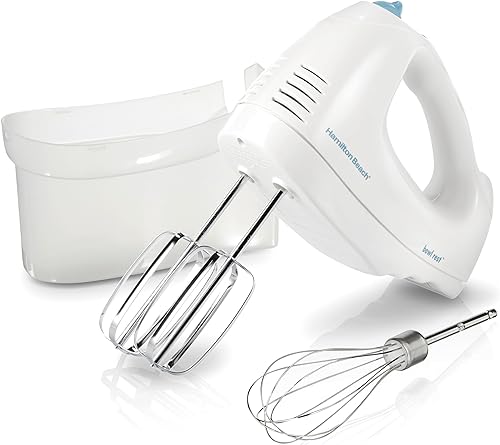
The Hamilton Beach 6-Speed pairs 6 speeds with QuickBurst, 2 traditional beaters, a whisk and a snap-on storage case. For flour prep before mixing, compare electric flour sifters.
Use your baking scales with either tool when you bake by weight for repeatable batter and dough.
The two tools side by side
The table below shows the practical gap: blending tools cut and puree, mixing tools beat and fold. Read the shapes first, then the power and attachments.
| Feature | Immersion blender | Hand mixer |
|---|---|---|
| Main job | Blend, puree, emulsify in the container | Beat, whip, fold and mix in a bowl |
| Where it goes | Shaft goes into pot, beaker or bowl | Beaters stay in a bowl, mixer stays above |
| Typical attachments | Blending stick, whisk, frother, chopper or processor | Traditional beaters, Turbo Beaters or whisk |
| Best foods | Soup, smoothies, sauces, baby food, puree | Cake batter, cookie dough, whipped cream, meringue |
| Speed control | Variable trigger or 2 speeds with TURBO | 5 or 6 stepped speeds |
The Turelar 400W model shows the simple end of blending. It has 2 speeds, a TURBO mode, a slim stainless steel shaft and a detachable blending stick.
That design fits pots and bowls where you want to puree without transferring hot food.
The KitchenAid 5 Ultra Power shows the controlled end of beating. It has 5 speeds, 2 stainless steel Turbo Beater accessories, a lockable swivel cord and a single-handed eject button.
Speed 1 suits chunky ingredients, while speed 5 suits whipping egg whites or cream.
Neither tool covers the other's main job well. Power numbers alone do not close that gap, because blade and beater shapes do different work.
Blending in the pot or beating in the bowl
Choose blending when food is in the pot and you want it smooth in place. Choose beating when you need air, even mixing or a thick mixture in a bowl.
The 1100W Turelar has a full copper motor and variable speed trigger for pureeing, emulsifying or whipping. Its nylon blade guard reduces suction and helps protect pots from scratches.
The 400W Turelar has a high-torque copper motor, pulse-activated sensor, 2 speeds plus TURBO, and a 2-pronged blade that cuts without trapping stem fiber or leaves. Both immersion blenders are corded, so check the outlet position first.
The Hamilton Beach has a 250 watt peak-power motor for cookie dough and whipped cream. The KitchenAid has 60 watts and 5 speeds for similar work at a steadier pace.
If you are torn between a stand mixer and a hand mixer for baking, read Is a Stand Mixer Better Than a Hand Mixer? before you decide.
Power and speed control
Hand mixers give stepped speeds for batter, while immersion blenders give trigger or TURBO control for purees. More speeds help most when you switch between folding and whipping in one session.
The Hamilton Beach offers 6 speeds plus QuickBurst. QuickBurst adds power on demand without setting a high speed for the whole recipe.
The KitchenAid offers 5 speeds with push button control. KitchenAid describes speed 1 for nuts and chocolate chips, and speed 5 for whipping meringues.
The 1100W Turelar offers 5 speeds with infinitely variable control. Its trigger lets you ease into a puree so splashing stays down.
The 400W Turelar offers 2 speeds with TURBO for tougher ingredients. Use short bursts with rest between uses, since large ice blocks or whole frozen fruit can cause overheating or damage, and long use on ice can burn the 1100W set.
Power ratings use different scales, so compare control feel for your recipes, not just watts. For cake work, our best tools for baking cake guide puts hand mixers in a wider baking context.
Attachments and what they actually do
Attachments decide whether one tool covers several jobs or stays focused on one. Count the parts in the box before you buy.
The 1100W Turelar set includes a stick blender, whisk, milk frother, 600ml mixing beaker and 500ml food processor. Attachments swap with a single click for frothing, whisking, pureeing or chopping.
The 400W Turelar includes only a blending stick. That keeps it simple and light, but you will need another tool for whipping or chopping.
The Hamilton Beach includes 2 traditional beaters and a whisk, plus a snap-on storage case. The beaters and whisk are dishwasher safe, and you press the speed dial to eject them.
The KitchenAid KHM512 includes the mixer and 2 stainless steel Turbo Beater accessories. The beaters are dishwasher safe, but no whisk is included.
The Turelar set gives more blending attachments, while the Hamilton Beach gives baking attachments in tidy storage. A pastry blender is a different tool for cutting butter into flour, and our guide on how to use a pastry blender tool explains that job.
For product options, see stainless steel pastry blenders.
Soups, smoothies, sauces and baby food
For hot soup and soft purees, the immersion blender is the clear winner. It lets you blend in the pot and skip transferring hot liquid.
The 400W Turelar is listed for smoothies, soups, baby food, sauces, dips and juices. Its slim stainless steel shaft fits most bowls, pots, breakers and containers.
The 1100W Turelar also suits hot soups, smoothies, baby food and purees. Turelar says it uses 100% food grade stainless steel and is safe with hot ingredients.
Add liquid while blending to improve performance and extend the blender life. That advice applies to thick purees on either model.
A hand mixer cannot do this job the same way. Its beaters are not guarded like a blending shaft, and hot soup is not a safe place for a bowl mixer.
For smoothies, start with liquid and softer ingredients, then add firmer items in stages. For baby food, you can puree cooked vegetables and fruit in the pot, then portion them after blending.
Cake batter, cookie dough, whipped cream and meringue
For baking, the hand mixer is the clear winner. Its beaters are shaped to mix thick batter, fold in ingredients and whip air into cream.
The Hamilton Beach suits cookie dough with chocolate chips and nuts, plus whipped cream. Its Bowl Rest feature holds the mixer on the bowl edge so drips fall in the bowl.
The KitchenAid suits cookie dough, mashed potatoes, egg whites and heavy cream. Its Turbo Beaters are designed to mix ingredients thoroughly in the bowl.
Start beating at a low speed, then raise it as the mixture thickens or lightens. That habit reduces splashing and helps you fold in flour or sugar evenly.
For meringue, use a clean, dry bowl and beaters, since grease or water can stop egg whites from whipping. For cake batter, mix until just combined and smooth, since overmixing can change the texture.
Our best KitchenAid hand mixer guide gives more detail on the KitchenAid option. If you make dough often, our best hand mixer with dough hooks guide covers that separate choice.
Weight, storage and daily use
A hand mixer asks you to hold it up for the whole mixing time, while an immersion blender asks you to hold it down in the food. That difference changes how tired your arm gets.
The Hamilton Beach weighs 1.3 kg and has a 5 ft cord. Its snap-on case holds the beaters, whisk and cord, which helps keep drawers tidy.
The KitchenAid weighs 2 pounds and measures 8 x 3.5 x 6 inches. Its lockable swivel cord keeps the cord out of your way while you move around the bowl.
The 1100W Turelar weighs 1.32 kg and measures 9.85 x 5.42 x 9.85 inches. Its ergonomic, non-slip grip is meant for steady control during continuous blending.
The 400W Turelar weighs 1.5 pounds and measures 5 x 2.5 x 8.5 inches. It has a top hanging ring for storage, plus a non-slip ergonomic handle.
If your arm tires easily, a best lightweight hand mixer search may fit you better, and a full set needs a clear shelf.
Cleaning and care in general terms
Clean both tools right after use, and keep water away from the motor unit. That rule protects the electrics and makes the next job easier.
For the 1100W Turelar, the blending shaft, whisk and frother are dishwasher safe up to 167 degrees Fahrenheit. Hand washing is still recommended, the motor unit and chopper lid can be wiped clean, and the white connection joints should stay dry.
For the 400W Turelar, the blending stick is detachable. The electronic and plastic part should not be washed in water, but can be wiped with a damp cloth.
For the Hamilton Beach, the 2 beaters and whisk are dishwasher safe. Press the speed dial to eject them after mixing.
For the KitchenAid, the Turbo Beaters are dishwasher safe. The single-handed eject button helps you remove them without touching the mixer head.
Avoid long runs on tough ingredients, and use short bursts with rest between them. Switch off and unplug before cleaning, especially with the 400W Turelar warning for ultra-sharp blades.
Hand mixer attachments and stand mixer questions
A hand mixer attachment is not a stand mixer attachment, and the reverse is not true either. The fit, drive and speed system differ by design.
That is why our guide on Can You Use a Hand Mixer Attachment on a Stand Mixer? is worth reading before you try to swap parts. The short answer is no, do not force it.
Use only the beaters, whisk or blending parts made for the exact model you own. Check that the attachment is latched before you press the switch, since Turelar warns idle running can damage the connection point or make it melt.
For hand mixers, make sure the beaters are fully seated before you start. A loose beater can wobble, splash and strain the motor.
If a part is damaged, ask for a replacement rather than using it loosely.
Who should buy which tool
Buy the immersion blender first if soups, smoothies and purees are weekly staples. Buy the hand mixer first if cakes, cookies and whipped cream are weekly staples.
Choose the Turelar 1100W set for a stick blender, whisk, frother, beaker and processor in one set. It suits cooks who blend often and want chopping and frothing covered too.
Choose the Turelar 400W for a simpler stick blender for soups, smoothies, baby food and sauces. Its 2 speeds and detachable stick keep the routine direct.
Choose the Hamilton Beach 6-Speed for 6 speeds, QuickBurst, a whisk and a snap-on case. Its storage helps if attachments tend to get lost in drawers.
Choose the KitchenAid 5 Ultra Power for 5 clear speeds and Turbo Beaters for batter, dough and cream. Its swivel cord and eject button suit steady, frequent baking.
Skip the immersion blender if you rarely blend in a pot and mostly bake. Skip the hand mixer if you rarely bake and mostly make soup, smoothies and sauces.
Immersion blender vs hand mixer: final pick
Pick the tool that matches your most common recipe, then add the second tool when that job becomes weekly. For many kitchens, the hand mixer comes first for baking, and the immersion blender follows for soups and smoothies.
In this comparison, the Turelar 1100W set scored highest for range and blending power. The Hamilton Beach 6-Speed scored close behind for baking control and storage.
The Turelar 400W is the simpler blending pick when you do not need a full set. The KitchenAid 5 Ultra Power is the controlled beating pick when you bake with clear speed steps.
Start with the job you do this week, not the job you might do someday. That choice keeps the tool out of the drawer and in your hand.
If you bake most, start with a hand mixer and use baking scales for repeatable results. If you blend most, start with an immersion blender and blend in the pot where you cook.
Either way, match the attachments to the food in front of you. That match, more than the power number, decides which tool you will reach for.
Adding the second tool later only makes sense once that job is routine.
Frequently asked questions
Can an immersion blender replace a hand mixer?
No, an immersion blender cannot replace a hand mixer for most baking. It purees and blends in a pot or beaker, but hand mixer beaters are shaped to fold air into batter, whip cream and mix thick dough evenly in a bowl.
Can a hand mixer blend soup in the pot?
No, a hand mixer is not a safe or practical way to blend hot soup in the pot. Its beaters are made for bowls, while an immersion blender has a shaft and blade guard designed to go into the pot and puree in place.
Which is better for whipped cream?
A hand mixer is better for whipped cream because its beaters and whisk move air through the cream in a bowl. An immersion blender with a whisk attachment can whip small amounts, but a hand mixer gives you more control over volume and texture.
Which tool takes less storage space?
It depends on attachments. A stick blender with a single blending stick is slim and easy to hang or tuck in a drawer, while a hand mixer with beaters, a whisk and a case needs a defined spot.
A multi-attachment set needs the most room.
Do I need both tools?
Many cooks use both because the jobs overlap only a little. If you make soup, smoothies and purees often, add an immersion blender.
If you bake cakes and cookies often, a hand mixer earns its space first.


