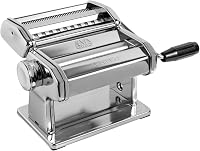
6 Best Electric Pasta Rollers (November 2026)
The best electric pasta roller machines include the GVODE Electric Pasta Maker Machine for compact storage, the GVODE Electric Pasta Maker Machine for a stainless steel housing, and the Sur La Table Kitchen Essential Va Bene for a manual alternative.
On this page (4 sections)
The best electric pasta roller machine for most home cooks is the GVODE Electric Pasta Maker Machine, which has 8 thickness settings, 2 speeds and reverse. Choose the stainless steel GVODE if housing material matters, or the Maxceysen for its built-in motor.
These machines flatten dough you have already prepared. They are different from mixer attachments and hand-crank rollers, so think about how often you make pasta and whether you want to guide dough by hand or let a motor drive it through the rollers.
A microwave pasta cooker cooks pasta rather than rolling fresh dough.
For compact options, see handheld pasta makers.
Our picks at a glance
-
1
-
2
 Best for a stainless steel housing
GVODE Electric Pasta Maker Machine
9.6/10 our score
See it on Amazon -
3
 Best for a manual alternative
Sur La Table Kitchen Essential Va Bene
9.2/10 our score
See it on Amazon
- 4
 Check it
MZTOGR 3-in-1 Pasta Maker Machine
Best for added ravioli tools - 5
 Best for a straightforward hand-crank setupCheck it
- 6
 Check it
Maxceysen Domestic Electric Pasta Maker Automatic Stainless
Best for a built-in motor
How we chose electric pasta roller machines
We compared motor operation, thickness controls, reverse functions, housing materials and included cutters. The picks are ordered by how well their stated features match the needs of someone shopping for a motor-driven roller.
Only 3 of the 6 products here are electric. The Sur La Table, MZTOGR and METLUCK models are manual machines included to make the trade-offs clear; they are not substitutes if you require a motor.
For a wider overview, see our pasta maker machine guide.
| Product | Best for | Thickness | Controls | Included | Our score |
|---|---|---|---|---|---|
| GVODE Electric Pasta Maker Machine | compact storage | 0.4 to 2 mm | 2 speeds, off and reverse | Electric drive unit and 3-in-1 pasta attachment | 9.7 |
| GVODE Electric Pasta Maker Machine | a stainless steel housing | 0.4 to 2 mm | 2 speeds, off and reverse | Motor base, 3-in-1 attachment, brush and manual | 9.6 |
| Sur La Table Kitchen Essential Va Bene | a manual alternative | 9 adjustable settings | Pasta maker, detachable shaper, handle and clamp | 9.2 | |
| MZTOGR 3-in-1 Pasta Maker Machine | added ravioli tools | 0.5 to 2.5 mm | Pasta cutter, ravioli attachment and drying rack | 9.1 | |
| METLUCK Pasta Maker | a straightforward hand-crank setup | 1 to 4 mm | Pasta roller and cutter | 8.9 | |
| Maxceysen Domestic Electric Pasta Maker Automatic Stainless | a built-in motor | 7 options | 8.6 |
Which electric pasta roller machines fit different kitchens?
The GVODE models lead this roundup because they combine motor-driven rolling with multiple thickness settings and reverse. The Maxceysen is another electric option, while the manual picks show what you gain and give up without a motor.
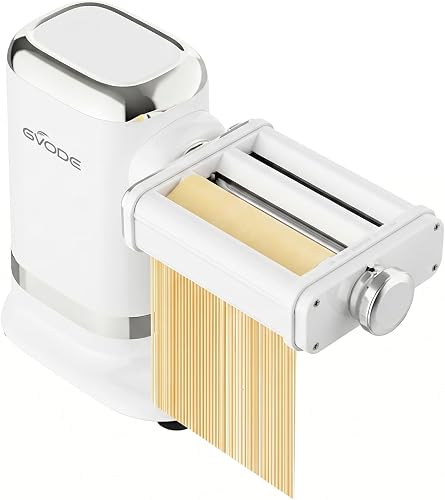
GVODE Electric Pasta Maker Machine: Best for compact storage
- 8 thickness settings from 0.4 to 2 mm
- 700W maximum power
- 2 speeds and reverse
- Plastic housing with metal drive gears
A light plastic housing and 8 thickness settings make this a flexible pick for cooks who want an electric roller that stores away between batches.
Pros
- Reverse can back out bunched dough
- 8 thickness settings
- Light housing for storage
Cons
- Requires 5-minute cool-down after 15-minute batches
- Plastic housing
The white GVODE is a strong match for cooks who want electric rolling but need to put the machine away between pasta sessions. Its plastic housing keeps the machine around 8 lb, and the maker describes it as light enough to move from counter to cupboard.
The 8 thickness settings range from 0.4 to 2 mm. Two speeds let you choose a slower or faster run, and reverse can help back dough out if it bunches.
Its 3-in-1 attachment combines a sheet roller with fettuccine and spaghetti cutters.
For cleaner cuts, GVODE recommends rolling the dough through the sheet roller 3 or 4 times at progressively thinner settings. It also advises running 15-minute batches with a 5-minute cool-down and keeping the motor vents clear.
Choose this model if you value adjustable sheets, reverse and lighter storage. The plastic housing is the key trade-off if you prefer an all-metal exterior.
GVODE Electric Pasta Maker Machine: Best for a stainless steel housing
- Stainless steel housing
- 8 thickness settings from 0.4 to 2 mm
- 700W maximum power
- 2 speeds and reverse
This GVODE pairs the same thickness range and motor controls as the white model with a stainless steel outer shell.
Pros
- Stainless steel housing
- Reverse control
- Brush included
Cons
- Requires 5-minute cool-down after 15-minute batches
- No weight given
This GVODE gives you motor-driven rolling with a stainless steel housing. It shares the white model's 8 thickness settings from 0.4 to 2 mm, 2 speeds and reverse.
The package includes a motor base, 3-in-1 attachment, cleaning brush and user manual. The attachment has a sheet roller, fettuccine cutter and spaghetti cutter, so it covers the main steps from flattening dough to making two noodle shapes.
GVODE recommends using the same 15-minute run and 5-minute cool-down rhythm, with vents left clear. If dough bunches, reverse can back it out; the maker also recommends rolling the sheet several times at thinner settings before cutting.
Pick this model when the stainless steel outer shell is more important to you than the lighter plastic housing of the other GVODE. Both have the same stated thickness range and motor controls.
Sur La Table Kitchen Essential Va Bene: Best for a manual alternative
- Manual hand crank
- 9 adjustable thickness settings
- Stainless steel body
- Fettuccine and spaghetti cutters
This is a manual roller rather than a motor-driven machine, but its 9 settings offer a useful comparison if you are weighing electric convenience against hand cranking.
Pros
- 9 adjustable settings
- Detachable pasta shaper
- Countertop clamp
Cons
- Requires hand cranking
- Hand wash only
The Sur La Table Va Bene is a manual pasta maker, so it does not meet the motor-driven requirement. It earns a place here as a comparison for cooks deciding whether the convenience of an electric machine is worth giving up a hand-crank option.
Its stainless steel body has 9 adjustable settings, and the detachable shaper cuts fettuccine and spaghetti. The handle fits into the roller and shaper, while a clamp supports the base on the countertop.
Choose it if you want a straightforward hand-crank roller with two cutter shapes. If the manual approach appeals, our guides explain how to use a manual pasta maker and how to use the Marcato Atlas 150 pasta machine.
MZTOGR 3-in-1 Pasta Maker Machine: Best for added ravioli tools
- Manual hand crank
- 9 thickness settings from 0.5 to 2.5 mm
- Ravioli attachment
- Drying rack included
The manual MZTOGR adds a ravioli attachment and drying rack, making it a feature-rich option for buyers who do not need motorized rolling.
Pros
- Ravioli attachment
- Drying rack included
- 9 thickness settings
Cons
- Requires hand cranking
- Not motor driven
The MZTOGR is another manual option, with a wider collection of tools than the simpler hand-crank picks. It has 9 thickness settings from 0.5 to 2.5 mm, spaghetti and fettuccine cutters, a ravioli attachment and a drying rack.
Its clamp secures the maker to a counter or table edge. The ravioli attachment forms square pieces with wavy edges, according to the product description.
This is a fit for cooks who want to make several pasta shapes and do not mind cranking by hand. It is not a motorized pasta roller, so choose one of the electric GVODE or Maxceysen options if avoiding manual rolling is the priority.
METLUCK Pasta Maker: Best for a straightforward hand-crank setup
- Manual hand crank
- 9 thickness settings from 1 to 4 mm
- 2 cutting blades
- Countertop clamp
METLUCK offers a basic manual roller and cutter with 9 thickness settings for cooks comparing an electric machine with a hand-cranked setup.
Pros
- 9 thickness settings
- Two cutting widths
- Tabletop clamp
Cons
- Requires hand cranking
- No motorized operation
METLUCK keeps the manual setup simple: a roller, two cutting blades, a hand crank and a tabletop clamp. Its 9 thickness settings range from 1 to 4 mm, while the cutters make 2 mm and 4 mm noodles.
The clamp helps keep the base steady as you turn the handle. METLUCK describes the cutter and handle as detachable for storage, and gives rinse-and-dry cleaning guidance.
Choose it if you want a compact manual roller and cutter for straightforward pasta shapes. If you want motor-driven rollers, this model won't provide them.
Maxceysen Domestic Electric Pasta Maker Automatic Stainless: Best for a built-in motor
- Built-in 60W motor
- Stainless steel construction
- 7 thickness options
- 2 noodle cutter widths
The Maxceysen has a built-in motor and stainless steel construction, with 7 thickness options and two cutter widths.
Pros
- Built-in motor
- Stainless steel construction
- Two cutter widths
Cons
- Avoid overly stiff dough
- May need at least a half-hour rest after overheating protection shuts it down
The Maxceysen uses a built-in 60W motor and stainless steel construction. It has 7 thickness options and two cutter heads, for noodles 2 mm and 6.5 mm wide.
The maker cautions against pressing overly stiff dough. It recommends cutting dough into 1 cm thick pieces and starting at the highest setting; if overheating protection stops the machine, the guidance is to turn it off for at least half an hour before trying again.
Choose it if a built-in motor and stainless steel body suit your kitchen. Its stated motor power is lower than the 700W maximum power on the GVODE models, and its dough guidance makes preparation worth considering before a large batch.
What should you check before choosing a motorized pasta machine?
Start with the dough you plan to roll, then compare the machine's thickness controls and motor guidance. The motor does the rolling, but it doesn't remove the need to prepare dough that feeds smoothly.
Which thickness settings do you need?
A useful electric pasta roller machine should cover the sheet thicknesses you plan to cook. The GVODE models span 0.4 to 2 mm, while Maxceysen gives 7 thickness options without the same range in the specs.
Thinner sheets suit delicate noodles and filled pasta, while thicker sheets can work for lasagna or dumpling wrappers. If you also want a hand-crank comparison, the best manual pasta maker options show different roller settings and cutter setups.
Are speed and reverse useful?
Two speeds give you a choice between slower feeding and a faster run, while reverse can back out dough if it bunches. Both GVODE models have these controls, which can help when you're learning how a dough batch moves through the rollers.
A reverse switch doesn't fix dough that is too sticky or stiff. Adjust the dough and feed it in manageable pieces, following the instructions for your machine.
How should you plan motor run time?
Motor limits matter if you intend to make several batches at once. GVODE recommends 15-minute runs followed by 5 minutes off, and says to keep the motor vents clear.
Maxceysen warns that overly stiff dough can cause slow rotation or a stop. Follow the operating guidance for whichever model you choose and give the machine time to cool if its protection shuts it down.
What can you make with a pasta roller?
A sheet roller can flatten dough for lasagna, filled pasta, dumpling wrappers and noodles that pass through compatible cutters. For hand cutting fresh pasta into portions, see pasta cutter wheels.
The included attachments vary, so check whether you need spaghetti, fettuccine or another shape before deciding.
Our guide to what you can make with a pasta roller attachment covers more uses. For a stand-mixer attachment instead of a standalone machine, compare the cost of a pasta roller attachment.
Which electric pasta roller machine should you choose?
Choose the white GVODE for its 8 settings, reverse and lighter plastic housing, or the stainless steel GVODE if you want the same controls in a metal shell. Pick Maxceysen if you prefer its built-in motor and stainless steel design, and choose a manual model only if hand cranking suits you.
If you're new to rolling pasta by hand, the Marcato Atlas 150 use guide explains the manual process. For motor-driven rollers, match the machine's dough guidance and run-time limits to the batches you plan to make.
Our top 3 picks at a glance
-
1
-
2
Best for a stainless steel housing
GVODE Electric Pasta Maker Machine
9.6/10 our score
See it on Amazon -
3
Best for a manual alternative
Sur La Table Kitchen Essential Va Bene
9.2/10 our score
See it on Amazon
Frequently asked questions
What does an electric pasta roller machine do?
An electric pasta roller machine uses a motor to pull prepared dough through rollers, flattening it into sheets without a hand crank. Many models also include cutters for noodles.
Check whether the machine has the thickness range and cutter shapes you plan to use.
Do electric pasta rollers knead dough?
No. These machines roll prepared dough into sheets, and some cut those sheets into noodles.
Prepare and knead the dough separately, then feed it through the roller in manageable pieces.
Very stiff dough can strain some motors, so follow the model's dough guidance.
How long can I run an electric pasta machine?
The GVODE models specify 15-minute batches followed by a 5-minute cool-down. Keep the motor vents clear while running.
Other machines can have different limits, so check their operating instructions before making a large batch.
Should I buy an electric or manual pasta roller?
Choose an electric roller if you want motor-driven sheets without turning a handle. A manual machine needs more effort but can suit occasional batches or cooks who prefer a simple hand-crank tool.
Compare the best manual pasta makers to see what those setups offer.