Tart Pan vs Pie Pan: Which Should You Use? (November 2026)
Choose a tart pan for shallow desserts with defined edges, or a pie pan for deeper fillings and easy table serving. The right choice depends on depth, sidewalls, base design and how you plan to release the bake.
On this page (8 sections)
- Tart pan vs pie pan: what is the difference?
- Which pan shape suits your recipe?
- Do removable bottoms make tart pans better?
- Is a multi-size tart pan set useful?
- Is a springform pan a better alternative?
- How do material and care differ?
- Which pan should a beginner buy?
- Tart pan vs pie pan: which should you use?
Choose a tart pan for shallow desserts with defined edges, or a pie pan for deeper fillings and serving from the dish. This comparison looks at depth, sidewalls and base design, which affect baking and release.
A tart pan usually has low fluted sides and a loose bottom. A pie pan usually has taller sides, a fixed base and room for a generous filling.
The best choice depends on the recipe, not just its name. A shallow fruit tart needs a different shape from a deep apple pie.
Think first about how much filling your recipe makes. A tart pan keeps filling shallow, so crust and topping stay in balance.
That suits custard, fruit and quiche where you want a neat slice with a visible edge. A pie pan gives filling more vertical room.
Extra depth helps with apple, pumpkin and other pies where filling is the main part of the dish. Higher crust sides also support the layers inside.
Sidewalls matter more than many bakers expect. Fluted tart sides press a pattern into pastry and help crust hold its shape.
Smooth pie sides give a simpler edge and make it easier to crimp the rim by hand. The base also changes how you serve the bake.
When a recipe is tall and fragile, a springform may fit best of all.

Tart pan vs pie pan: what is the difference?
A tart pan is shallow and release-focused, while a pie pan is deeper and serving-focused. Those differences affect crust shape, filling depth and how you move the finished bake.
Tart pans often have fluted sidewalls that press a pattern into the crust. Their removable bottoms let you lift the baked tart away from the ring after it cools.
Pie pans keep the bake inside one dish. That makes them useful when you want to cut and serve a pie from the same pan, but the crust usually stays attached to the base.
A useful starting point is the sidewall. For standard round cake diameters, see round cake pan sizes.
The RICHSC-PAN Tart Pan is 9 x 1.1 in, while the LE TAUCI ceramic pie pans are 1.7 in high. For help choosing dimensions, see our tart pan size guide.
That difference gives a pie pan more room for filling. It also gives a tart pan a lower profile that suits a crisp crust and a clean edge.
Which pan shape suits your recipe?
Match the pan to the filling depth and the way the crust should look. Use a tart pan for shallow fillings and a pie pan when the recipe needs taller sides.
Tarts often use a pastry shell that remains visible around the filling. Fluted sides add a shaped edge, and the removable base helps you transfer the cooled tart to a serving plate.
Pies can have a single crust, a lattice top or a full top crust. The fixed base supports that style during baking and keeps the pie ready to serve from the dish.
Quiche sits between the 2 styles. A shallow tart pan gives a firm, defined shell, while a deeper pie pan gives more space for an egg filling.
For a broader look at coordinated pans and dishes, see our guide to bakeware sets. It can help if you want several shapes instead of one dedicated pan.
When should you choose a tart pan?
Choose a tart pan for shallow pastries, quiche and desserts where the edge is part of the presentation. A removable bottom matters most when you want to lift the bake out instead of cutting it in the pan.
The RICHSC-PAN Tart Pan has a carbon steel body, non-stick coating, fluted sides and a removable bottom. Its 9 x 1.1 in size is suited to a classic shallow tart profile.
A removable bottom also changes how you cool the bake. Let the crust set before lifting the base, and support the tart from underneath as you move it.
See our guide to the best tart pans with removable bottom if release is your main buying priority.
When should you choose a pie pan?
Choose a pie pan when you want more filling room and plan to serve from the dish. A fixed base keeps the pie supported during baking, cooling and slicing.
The LE TAUCI Ceramic Pie Pans for Baking are a set of 2 white ceramic pans with a 9 in diameter, 1.7 in height and 36 oz size. For method and handling tips, see baking pie in a ceramic dish.
They are oven, freezer, microwave and dishwasher safe, with an upper temperature rating of 482 °F.
Ceramic also changes the handling experience. The pans weigh 1.6 pounds each according to the product data, so plan for a heavier dish than a thin carbon steel tart pan.
The wide fluted rim gives you a place to grip the pan and a guide for shaping dough. Since the base is not removable, cool the pie fully before cutting if you want cleaner slices.
Do removable bottoms make tart pans better?
Removable bottoms make tart pans easier to release, but they are not automatically better for every bake. They help when the finished pastry needs to leave the pan intact, yet they can require more careful handling.
A loose bottom lets you push the bake upward while the outer ring stays in place. This is useful for a tart shell with a fragile edge.
The RICHSC-PAN pan has a pie ring and plate as included components. Its product data lists a removable bottom, heavy-duty construction, non-stick coating and a 9 x 1.1 in size.
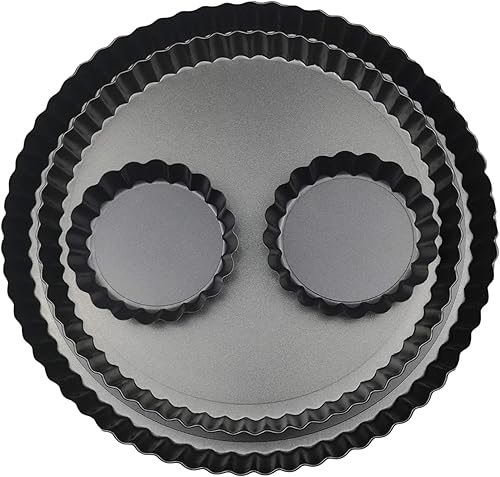
The Yamteck set uses the same general release idea across 4 pans. It includes one 11 in round tart pan, one 9 in round tart pan and two 4 in round tart pans, all with removable bottoms.
The trade-off is storage. A single tart pan is simple to keep in a drawer, while a 4-piece set gives more size choices but needs room for several pans.
For a wider comparison of shapes and materials, browse our picks for the best tart pans for baking.
Is a multi-size tart pan set useful?
A multi-size set is useful when you bake for different group sizes or want mini portions. It is less useful if you always make one standard tart and have limited storage.
The Yamteck 11 & 9 Inch Round Tart includes an 11 in pan, a 9 in pan and two 4 in mini pans. The main pans are 1.2 in deep, while the mini pans are 0.8 in deep.
The set uses carbon steel, non-stick coating and removable bottoms. Its 4-pan layout lets you choose a larger tart for a gathering or smaller tarts for individual servings.
The 11 in pan needs more oven and storage space than a 9 in pan. Measure your oven rack and cupboard before choosing a larger set.
For smaller bakes, our guide to the best mini tart pan covers the size and release features to compare.
Is a springform pan a better alternative?
A springform pan is better for tall, delicate desserts than for a classic shallow tart. Its removable side band releases the bake around the sides, while its taller wall supports more filling.
The Nordic Ware Springform is a 9 in carbon steel pan with a 3.1 in height and 10 cup capacity. It has a removable band, a sturdy buckle and a non-stick surface made without PFOA.
The springform differs from a tart pan in both height and release direction. A tart pan lifts from the base, while a springform opens its sidewall around the dessert.
That makes the springform useful for cheesecake, but it does not create the low fluted edge associated with a tart. Choose it when height and side release are the main needs.
Do not fill any pan beyond the recipe's safe level. For the Nordic Ware pan, the care guidance says to fill no more than 3/4 full to help avoid overflow.
How do material and care differ?
Carbon steel tart pans heat and handle differently from ceramic pie pans, so care should match the material. Both can work well, but they suit different routines.
The RICHSC-PAN and Yamteck pans use carbon steel with non-stick coating. Their care information recommends protecting the coating and washing by hand, even though the Yamteck product data also lists dishwasher-safe construction.
Avoid metal utensils, steel wool and abrasive cleaners on non-stick surfaces. Use a soft tool to loosen any edge that sticks, then dry the pan promptly.
The Nordic Ware Springform is also carbon steel with a non-stick surface. Its care instructions recommend hand washing with warm, soapy water and avoiding scouring pads and abrasive cleaners.
The LE TAUCI pans use ceramic and are dishwasher safe. They are also freezer, microwave and oven safe up to 482 °F, but follow the recipe and appliance guidance when moving ceramic between temperature environments.
Ceramic can be a good fit when the pan will go from baking to serving. Carbon steel can be more convenient when a lighter tart pan and removable base matter most.
If you prefer ceramic tart shapes, compare the options in our guide to the best tart pan ceramic.
Which pan should a beginner buy?
A beginner should choose a pie pan for simple serving or a tart pan with a removable bottom for easier release. Pick the shape that matches the recipes you expect to make most often.
Choose the RICHSC-PAN pan if you mainly want one standard shallow tart pan. Its fluted sides and removable bottom give you the classic tart format without adding several pieces.
Choose the Yamteck set if your recipes vary from mini tarts to a large 11 in tart. The extra sizes are useful, but they add storage and cleaning needs.
Choose the LE TAUCI set if you want 2 ceramic pie pans for deeper bakes and table service. The 1.7 in height gives more filling room than the 1.1 in RICHSC-PAN pan.
Choose the Nordic Ware Springform if cheesecake and other tall desserts are more important than fluted tart edges. Its 3.1 in height and 10 cup capacity make it the tallest option here.
A stand mixer can also affect your choice of recipes. For crust work, see Best Stand Mixer For Pie Dough and How to Make Pie Dough in a Stand Mixer?.
Tart pan vs pie pan: which should you use?
Pick a tart pan for shallow crusts, fluted edges and release from the base. Pick a pie pan for deeper fillings, fixed support and serving from the dish.
A springform is better when your bake needs taller sides and side release. The RICHSC-PAN Tart Pan is the strongest match for one classic shallow tart.
The Yamteck set wins when you need several tart sizes, while the LE TAUCI set suits deeper ceramic pies. Choose Nordic Ware for tall desserts, not a traditional tart.
Measure recipe depth, oven space and storage area before you buy. Start with the RICHSC-PAN for classic tarts and quiches.
Its removable bottom helps you release a shallow bake cleanly, and its fluted sides give the crust a finished edge. Choose the Yamteck set when your baking varies in size.
One set can cover a large tart for a group and smaller tarts for individual portions. You will need storage for four pans.
Choose the LE TAUCI ceramic set for deeper pies and serving at the table. Its fixed base and higher sides suit fillings crowded in a shallow tart pan.
Choose Nordic Ware when height matters most. Its taller wall and removable band suit cheesecake and delicate desserts.
If you are also organizing other baking supplies, our Best Loaf Pan Liners guide can help with a related bakeware choice.
Match depth to filling before you check anything else. A shallow pan can make a deep filling spill or bake unevenly.
A deep pan can leave a shallow tart looking lost. Check oven space for larger pans and storage for sets.
A pan that is hard to store is easy to avoid, even if its shape suits the recipe. Care should follow the material you pick.
Non-stick carbon steel needs gentle washing, while ceramic can handle a different routine.
Frequently asked questions
What is the main difference between a tart pan and a pie pan?
A tart pan is usually shallower and often has fluted sides with a removable bottom, while a pie pan is deeper and keeps the crust in the dish for serving. Choose a tart pan for a neat released edge, or a pie pan for deeper fillings and table presentation.
Can you use a pie pan for a tart?
You can bake a tart in a pie pan, but the result may have deeper sides and a less defined edge than a tart made in a tart pan. Use a pie pan when the recipe has more filling, or when you plan to serve the dessert directly from the dish.
Can you use a tart pan for pie?
You can use a tart pan for some pies, especially shallow fruit or custard pies, but check the recipe depth first. A removable bottom can make release easier, while the shallow sides leave less room for a tall filling or a large crust edge.
Is a springform pan the same as a tart pan?
No. A springform pan has a removable side band and is usually taller, while a tart pan is shallower and often has fluted sides with a removable base.
A springform suits tall cheesecakes and delicate desserts; a tart pan suits shallow tarts and quiches.